

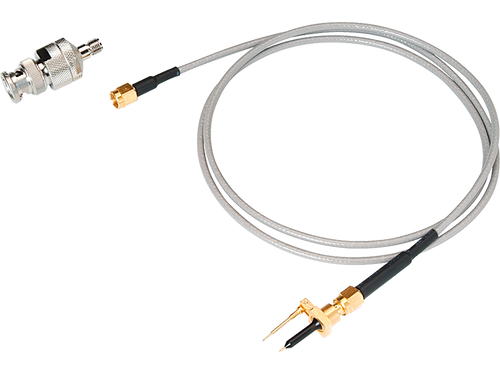
Yokogawa 701974 - Low Capacitance Probe GHz
Write a Review
Yokogawa
Yokogawa 701974 - Low Capacitance Probe GHz
- Brand
- Yokogawa
- SKU:
- 701974
- Availability:
- Y
Yokogawa 701974 - Low Capacitance Probe GHz
Yokogawa 701974 - Low Capacitance Probe GHz| Bandwidth | : | DC to 5 GHz (-3 dB) |
| Attenuation | : | 10:1 or 20:1 (±2%) |
| Input resistor | : | 450 ? or 950 ? (±1%) |
| Input resistor | : | 500 ? or 1000 ? (when used with 50 ? scope input / termination) |
| Input capacitance | : | approx 0.25 pF (typ. 450 ?), 0.4 pF (typ. 950 ?) |
| Max. input voltage | : | 20 Vrms (40 VACpeak) |
| Probe Length (coax) | : | 1.1 meter |
Specifications:
Bandwidth: DC to 5 GHz (-3 dB)
Attenuation: 10:1 or 20:1 (±2%)
Input resistor: 450 ? or 950 ? (±1%)
Input resistor: 500 ? or 1000 ? (when used with 50 ? scope input / termination)
Input capacitance: approx 0.25 pF (typ. 450 ?), 0.4 pF (typ. 950 ?)
Max. input voltage: 20 Vrms (40 VACpeak)
Probe Length (coax): 1.1 meter
Overview:
Oscilloscope Probe Capacitance
Low capacitance probes are a type of passive, analog voltage probe, alongside high voltage and general-purpose probes. The most basic probe, a passive probe, is also the most versatile. When used with select attachments, passive probes can be used with higher-speed signals. Additionally, Yokogawa Test&Measurement provides probes for extreme cases including high-voltage, wide temperature ranges, and high-speed signal measurement.
Measuring Capacitance with an Oscilloscope
How to measure capacitance with an oscilloscope: Measure the time of charging to a given voltage using a simple circuit for a capacitor in series with a resistor. Then, the oscilloscope helps to measure the voltage across the capacitor.
0 Reviews Hide Reviews Show Reviews

Yokogawa
Yokogawa 701924 - Differential Probe 25V / 1 GHz

Yokogawa
Yokogawa 90029B - temperature probe
Yokogawa
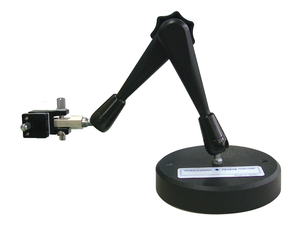
Yokogawa 701919 - Probe Stand
Yokogawa
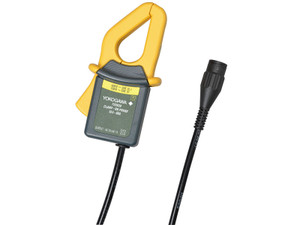
Yokogawa 720930 - Clamp on Probe

Yokogawa